

In this article, we’ll talk about property management systems (PMSs) that handle reservations, front- and back-office operations, channel management, and more. You’ll learn about the main functions of PMSs, compare products available from different providers, and receive recommendations on how to choose the most suitable system for your hospitality business.
What is a property management system?
A property management system (PMS) is software that facilitates a hotel’s reservation management, administrative tasks, and guest experience. The most important functions cover reservation and rate management, check-in/checkout, guest profiles, billing, housekeeping, maintenance, and reporting. More advanced tools include CRM, reputation management, channel management, and more.

Hotel PMS overview
According to the 2026 Hotel PMS Impact study, 91 percent of hoteliers believe that PMS directly drives revenue growth, while 89 percent of hotel operators recognize the system saves them 2-10 hours per wek. It has evolved from a platform for recording transactions to a control hub for all hotel operations, impacting everything from labor efficiency to the guest experience. So let’s see what all this software is about and how it supports hospitality businesses.
Main modules of property management systems
A modern property management system integrates multiple work environments into a single platform. Depending on the provider, the combination of modules and their functions can vary. Some vendors sell their systems as separate components that can be integrated with an existing solution used by a hotel. Here is the basic structure of a hotel PMS.
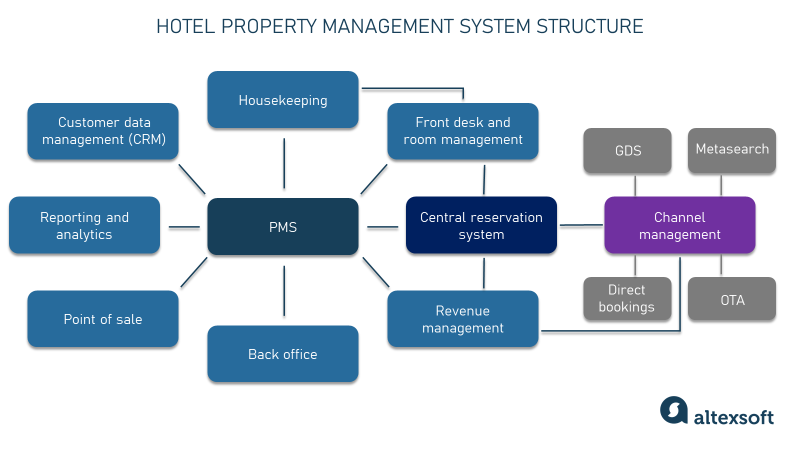
A general structure of property management system
In this post, we’ll only provide brief descriptions of the PMS modules, but you’re welcome to visit our dedicated overviews to learn more about each one.
Core PMS operations: front office, reservations, room and rate management
A front office module focuses on connecting with and servicing guests. Traditionally, it’s centered around the front (reception) desk, allowing a hotel manager to view and update room reservation status, check guests in and out, and process payments. However, today, many PMSs offer contactless check-in and checkout, as well as other self-service activities, via tablet-based kiosks or mobile apps.

Front-desk operations interface. Source: Crozdesk
Other core PMS functions include the follows.
Reservation and room management. It allows the staff to check availability and rates, create, change, and cancel reservations for individuals, corporate travelers, and groups, update room status, etc.
Billing. Hoteliers can charge guests for their bookings and other purchases and issue receipts.
Guest /company/travel agent profile management. A part of PMS operations is collecting consumers’ data (email, phone, consent) to create and update guest profiles. This information is used for check-in, capturing guest preferences, tracking loyalty members, delivering personalized experiences, and billing. Also, this component enables hoteliers to create and maintain profiles for corporate customers and travel agencies.
Direct distribution via booking engine
An important channel of distribution is a hotel's own website with a booking engine. An online booking engine allows travelers to complete reservations directly via a hotel website bypassing travel agents and OTAs.
Here’s why direct bookings are crucial for hotels
A booking engine must be integrated with the channel manager so that whenever a reservation occurs, availability is instantly updated across all distribution channels. Usually, this module also processes payments via integrated payment gateways, supports upselling (selling room upgrades or complementing services), and packaging.
We have booking engines covered here.
Central reservation system
A central reservation system (CRS) acts as the unified hub for hotel groups and chains, providing comprehensive control over inventory, rates, and bookings across multiple properties. It handles:
-
centralized inventory and rate management,
-
call center reservations,
-
a unified guest database,
-
sometimes — channel management (in this case, you don’t need a separate tool), and
-
advanced reporting.
Conversely, small-to-mid-sized hotels and independent properties increasingly adopt unified platforms that combine PMS, CRS, and channel management into a single solution to reduce complexity and improve cost efficiency. However, the embedded CRS component does not fully replace a standalone enterprise CRS: its capabilities are typically limited to centralized inventory and rate management, basic reservation control, and lightweight multi-property support.
Visit a CRS explainer for more details.
CRM and personalization
While the front desk and CRS modules capture guest data, an integrated CRM (Customer Relationship Management) module aggregates and analyzes it for marketing activities. The CRM helps personalize promotions and e-mail campaigns, measure guest experience, and automate pre- and post-stay services. Often, it includes reputation management capabilities to monitor guest reviews on social media and other online platforms.
By keeping complete guest profiles and preference data, the CRM helps owners personalize guest experience and enhance their stay.
Please read more about CRM software and hotel guest experience in dedicated posts.
Point-of-sale services
Most hotels have some kind of in-house restaurant, not to mention properties with gyms and spas. So, if there are multiple payment terminals in a hotel, the point-of-sale (POS) system is indispensable to collect and accurately handle transactions from different sources. With a POS module in their PMS, hoteliers can include additional charges or discounts to the final bill for each customer. Some examples of such charges are
-
spa, gyms, and other activities;
-
food and beverage services (restaurants, cafes, breakfasts); and
-
in-room services, mini-bar items, TV, or Wi-Fi.
In addition to automated payment processing, a comprehensive POS module can support inventory management, collect information about customer purchasing patterns, generate sales activity reports, and keep financial data in one place.
Check out the complete POS software overview here.
Revenue management
A revenue management system (RMS) enables hoteliers to modify rates and availability across all channels to achieve better financial results. It helps monitor and forecast such hotel KPIs as occupancy rate, RevPAR (revenue per available room), and ALOS (average length of stay), and dynamically alter prices to maximize overall revenue. To make these adjustments as accurate as possible, various types of data are factored in, such as seasonality, weather, local events, public holidays, and so on.
In recent years, RMSs have evolved from relying on human-set rules and predefined parameters to utilizing AI-driven analytics and real-time price optimization. Studies show that 86.1 percent of hoteliers already use AI for demand forecasting, reporting a 17-percent increase in total revenue compared to legacy RMSs. Additionally, AI-powered dynamic pricing has the potential to boost the average daily rate (ADR) by 10-15 percent.
Check out a separate post about hotel revenue management systems.
Back-office management
This PMS module connects operations with financial processes. Its core functions are as follows.
Accounting and financial management — maintaining the general ledger, processing accounts payable and receivable, reconciling bank transactions, and ensuring accurate tax calculation for compliance.
Inventory and procurement management — monitoring stock levels for food, beverages, and supplies, creating purchase orders, and managing vendor relationships to control costs.
Financial reporting — generating profit and loss statements, balance sheets, cash flow analyses, and audit trails to support decision-making and regulatory requirements
The back office integrates with POS, CRS, RMS, and other modules and can export data to external accounting software.
Reports and analytics
To monitor current processes and understand business performance, all business owners rely on analytics. A PMS can serve as a business intelligence tool, collecting relevant hotel data and providing hoteliers with various types of automated reports. Depending on the software, it can generate night audit reports, room and tax reports, shift audit reports, departure/arrival reports, housekeeping reports, or other ongoing summaries.
As for the analytics functionality, monitoring the main hotel KPIs is essential for gaining a full picture of the property's performance and making data-based decisions.
Open APIs
Application programming interfaces (APIs) are pieces of programming code that connect different software systems and enable data exchange. Open APIs publicly available for other developers and systems are crucial for modern PMS software. Given the many diverse solutions hotels use, there must be a way to integrate these tech tools into one ecosystem. Contactless check-in, guest experience apps, and smart locks are only a few examples of instruments that can be connected via an API.
Efficient data exchange reduces the need for manual data entry, decreasing errors and freeing up staff time. It also enables more comprehensive data collection for analysis.
How to choose PMS software
The choice of a PMS depends on the size and type of a hotel property, as different systems have their own sets of core features and additional modules. Most players in the market offer hotel management systems that can be customized for different types of property and basic PMS components can be complemented with modules, required for a specific type of business.
The 2023 Smart Decision Guide to Hotel Property Management Systems by Oracle provides an evaluation checklist to help hoteliers make the right decision, rating each factor from 1 (absolutely not important) to 10 (very important). This checklist is also very useful for comparing systems from different vendors. Regardless of hotel size and type, consider the following:

The Evaluation Checklist. Source: The 2023 Smart Decision Guide for to Hotel Property Management Systems
The final decision is largely shaped by the functionality required. But there are other considerations to keep in mind.
Check integration options. If there are systems already used by a hotel, or if you plan on integrating additional software, make sure that your vendor supports all necessary APIs and is ready to provide integration services. Otherwise, you may consider an external technical consultant to provide integration services.
Consider a cloud solution with mobile access. Cloud solutions are generally less expensive than on-premises software. Users avoid maintenance expenses and pay a subscription fee, which depends on the number of rooms in a hotel and the modules they require. Also, cloud software is better at integrating with third-party systems like OTAs, bed banks, and GDSs.
On top of that, cloud-based systems can be constantly and seamlessly updated, and usually have a mobile version. Mobile access facilitates communication across departments (front-office, management, housekeeping, etc.) which helps improve customer service.
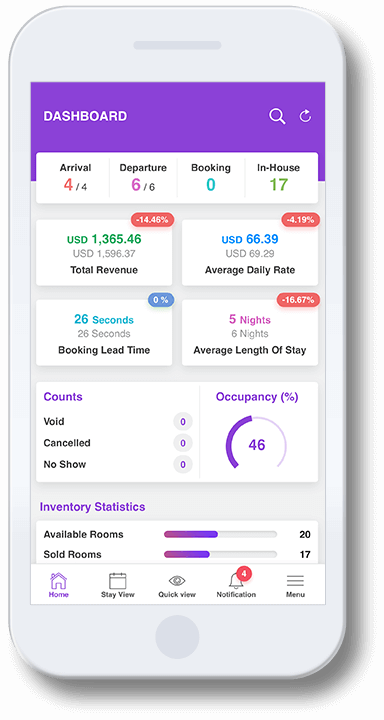
Mobile interface of a hotel PMS. Source: eZee Absolute
Pay attention to the degree of customization offered by a provider. Depending on the size and type of a property, PMS requirements may differ. For instance, if you need a bed-based management system instead of a room-based one in the front-office module, make sure that the PMS vendor can provide this sort of customization.
Prioritize ease of use. The system’s UX will impact your employees’ learning curve. The more complex and unintuitive the interface, the more time you have to invest in staff training and transitioning. Also, ask the vendor what kind of training they provide and if it’s included in the cost.
Assess customer support. Anything can happen to software, but it must not affect the hotel service. Hoteliers need 24/7 access to technical support. When choosing a PMS, look for customer support reviews from fellow hoteliers or negotiate all support terms with your vendor in detail to ensure that any software outages won’t have a dramatic impact on your operations.
Calculate ROI and spending. Whether you want to update an existing property management system, build a custom one, or buy an off-the-shelf solution, decide how much you’re ready to spend on it. To make sure that the PMS will pay off, consider these key factors:
-
time currently spent and how it will be reduced as a result of automation;
-
how distribution and revenue will change; and
-
cost of system implementation, integration, and ongoing maintenance.
Oracle also suggests, when choosing a PMS, paying attention to security and data protection measures as well as the provider’s track record.
We’ve explored some of the popular PMS products across different categories. Since we can’t describe all systems in detail in this post, we’ve condensed essential info about most of them in comparison tables to give you an idea of what to expect. Please note that tables don’t include core PMS functionality — front-office and back-office operations, rate and reservation management, housekeeping, and reporting/analytics. Also, note that the categorization we offer is approximate since most platforms today are becoming increasingly universal.
Enterprise-grade systems for large properties and global hotel chains
Hospitality organizations operating across multiple regions and property types require a PMS that goes well beyond basic reservations, front desk, and housekeeping functionality. Such platforms support multi-property operations and corporate travel flows, provide centralized governance with local flexibility, and integrate seamlessly with specialized systems for sales and catering (events and meetings), loyalty, revenue management, and digital guest services.
All the solutions we review below are not all-in-one systems but rather enterprise-grade PMS software embedded in a broad hospitality ecosystem. This way, hotel chains can find deep functional coverage from a single vendor.

Property management systems for large hotel chains, global brands, and large full-service hotels
OPERA Cloud PMS by Oracle
Oracle has been providing solutions for hospitality, including PMS, for about 50 years. According to the 2025 PMS Vendor Assessment by IDC MarketSpace, OPERA Cloud Property Management, a modern version of OPERA 5 PMS, has its largest portion of clients in the midscale segment, closely followed by higher-priced, full-service, and budget brands. The growing area for OPERA Cloud is the luxury and resort.
OPERA Cloud is recognized for its global reach, as it’s now compliant in 233 countries and territories, supports 21 languages, and all major currencies. The key capabilities it offers across geographies and market segments are:
-
customizable dashboards and workflows that enable independent hotels and chains to tailor the UI for unique operational needs;
-
a centralized guest profile to track stays and preferences of customers across properties;
-
loyalty management that allows for segmenting customers based on behaviours, designing loyalty programs, measuring the value of corporate customers, and more;
-
a look to book feature allowing staff to identify the best rate, package, and room-type combination, offer upgrades and add-ons, and turn shoppers into bookers;
-
vacation ownership, enabling addition and management of vacation rentals;
-
payment processing supporting various options — pay-by-link, debit and credit cards, and digital wallets (Apple Pay, Google Pay, Samsung Pay); and
-
real-time business insights.
OPERA Cloud natively integrates with other Oracle products, such as the OPERA Cloud Distribution (a channel manager), OPERA Cloud Central (an advanced CRS, aggregating data and functionality from various modules into a unified interface), Simphony POS for food and beverage outlets, Sales and Event Management, and Guest Engagement and Merchandising tools.
At the same time, OPERA Cloud PMS and the overall Oracle hospitality platform do not offer full-scale AI, though several enhancements like a GenAI assistant are to be launched in 2026.
If you want to integrate OPERA PMS with a third-party solution, please check out our detailed overview with practical guidelines.
Amadeus Cloud Property Management
Amadeus is another big name in the travel industry (if you don’t know why, check our GDS comparison). It provides tech solutions for airlines, airports, travel agents, and hotels. Similar to Oracle, Amadeus has two core PMS products:
-
IDPMS — an on-premises legacy product still used in some regions; and
-
Amadeus Cloud Property Management — a modern, cloud-native solution.
For new implementations, the cloud version is the natural choice unless specific legacy requirements exist.
Amadeus Cloud PM streamlines core PMS operations (front desk, reservations, and rate management, guest profiles, and housekeeping), while expecting you to integrate add-on modules for other functionality. It benefits from native connectivity with Amadeus GDS and an extensive suite of hospitality solutions. You can easily team the PMS with
-
iHotelier® Reservations & Booking Engine — a CRS with an in-built booking engine and channel manager that enables distribution across 300+ partners — global and regional OTAs, GDS systems, and metasearch sites;
-
Hotel Guest Management System (GMS) — an advanced CRM, to increase hotel guest loyalty;
-
Delphi Sales & Catering — for event and group management;
-
Travel Intelligence for Hotels — for advanced demand forecasting and revenue strategies; and
-
Amadeus HotSOS — for enhanced housekeeping, mobile workflows, and two-way real-time communication between the PMS and operational staff tools.
While major hotel chains like Hilton and Marriott largely rely on Oracle, Amadeus hospitality solutions are also optimized for complex operating environments, with built-in support for multiple languages, currencies, and tax structures. In practice, many hotels running on OPERA Cloud complement it with iHotelier for distribution.
Mews PMS
Founded in 2012, Mews PMS powers over 2,500 hotels in 85 countries. Mainly serving mid-market and boutique players, the platform has recently added several enterprise-grade clients, including Best Western in Europe, Choice Hotels International, and The Leading Hotels of the World Group.
Today, Mews is marketed as a PMS with integrated payments, designed to transform hotel operations into a profit center by focusing on revenue generated from the entire guest stay, rather than just from the occupied room.
The system is frequently praised for its user-friendliness, easy onboarding process for new staff, and flexible deployment options. In addition to core front-desk, housekeeping, and reservation management functionality, Mews offers several embedded modules:
-
booking engine supporting non-room reservations, such as parking, bike rentals, campsites, etc;
-
event booking and management tool, designed to optimize revenue from MICE (Meetings, Incentives, Conferences, and Exhibitions) tourism;
-
unified payment platform for both POS and PMS;
-
digital key, mobile/tablet kiosk, and digital concierge for self-service guest interactions, including check-in/check-out; and
-
business intelligence features to enhance decision-making.
Recent upgrades have centered around guest data management automation, aiming to improve the guest experience while reducing labor costs. For example, AI-powered Smart Tips help staff identify upsell opportunities and recognize returning guests. Another key feature, Mews Space, facilitates flexible booking options (hourly, daily, nightly, monthly), capturing dynamic pricing opportunities while catering to the growing demand for extended stays.
While core Mews PMS includes basic rate management functions (e.g., standard rate setup and updates), more advanced capabilities are provided through the Atomize RMS, an AI-powered revenue management system acquired by Mews in 2024. This tightly integrated platform delivers dynamic pricing and forecasting, enhancing Mews' overall revenue management suite.
Regarding localization, Mews supports five languages for business communication: English, French, German, Spanish, and Dutch.
All-in-one PMS solutions for individual properties and small to medium-sized hotel groups
These PMSs are full-featured, cloud-native platforms built for traditional hospitality businesses—such as hotels, resorts, and B&Bs—that require an all-in-one system for operations, distribution, and guest management. The core offering may include an embedded payment gateway, staff web or mobile apps, a booking engine, and a channel manager, with some capabilities unlocked only at higher pricing tiers. They also support multi-property functionality primarily targeting small-to-mid-sized hotel groups.
At the same time, these PMSs are relatively flexible: properties can select only the modules they need and extend functionality—such as marketing, channel management, or revenue tools—through third-party integrations. Most platforms come pre-connected with a broad ecosystem of partners, making it easier to tailor the setup without heavy custom development.

PMS platforms for independent hotels, small and medium-sized hotel chains and groups, and other traditional properties
Cloudbeds
Cloudbeds connects operations, distribution, and guest experience in one system, serving hotels in 150+ countries. It is primarily used by independent hotels, boutique properties, hostels, and small to mid-sized hotel groups that want an all-in-one cloud platform without the complexity of enterprise PMS solutions.
The functionality you’ll get depends on the price plan. The most basic configuration covers core PMS features, an embedded payment gateway, and connectivity to more than 400 integration partners. At the next tier, Cloudbeds channel manager and booking engine are added. The third level gives you guest experience and reputation management tools.
Cloudbeds also provides revenue marketing add-ons fueled by Signals, a hospitality-specific AI model designed to boost revenue per available room (RevPAR). This includes:
-
Revenue Intelligence;
-
Guest Marketing CRM;
-
Digital Marketing Solution; and
-
Website Builder.
A reputation management tool can also be purchased as a separate module.
eZee Absolute
eZee Absolute by eZee Technosys is an industry-recognized, all-in-one hospitality platform targeting budget independent hotels, hostels, and small to mid-sized hotel chains. Acquired by Yanolja, the South Korean travel-tech unicorn, in 2019, the platform has a strong footprint in Middle East and Asian markets, particularly Southeast Asia, India, and Taiwan.
As with Cloudbeds, functionality depends on the selected pricing tier. The entry-level plan includes the core cloud PMS only. The next tier adds either a booking engine or a channel manager pre-connected with more than 130 distribution partners. To access both components, properties need to upgrade to the highest tier, which is also the most widely adopted plan among customers.
In addition, eZee offers a website builder and a reputation management solution that aggregates guest reviews from OTAs, TripAdvisor, and other travel platforms. The reputation module applies sentiment analysis to help hotels understand guest feedback, identify recurring issues, and respond more effectively to online reviews.
Hotelogix
Similar to eeZe Absolute, Hotelogix has a strong presence in the Middle East and Asian markets, with headquarters in Singapore and major offices in India and Thailand. At the same time, the platform operates globally, serving more than 12,000 hotels across 100+ countries and supporting 13 languages.
Even in the basic plan, Hotelogix complements core PMS functionality with a booking engine, POS software, and Review Express, a reputation management tool that automates guest feedback collection from TripAdvisor. Higher pricing tiers add a channel manager, GDS connectivity, an integrated payment gateway, revenue management capabilities, and accounting features. Additional tools include Loyalty Connect, which enables API-based integration with third-party loyalty and CRM systems, and Trip Connect, which allows guests to book hotel inventory directly through TripAdvisor.
Little Hotelier
Little Hotelier is a cloud-based solution for small hotel properties, like B&Bs, hostels, and guesthouses. It also has separate offerings for lodges and apartment management.
The PMS is powered by SiteMinder and integrates with this reservation platform. However, it also allows third-party integrations. Little Hotelier combines all necessary modules for a hotel in one PMS:
-
front-desk management,
-
reservation management,
-
channel manager with online booking engine,
-
payment processing, and
-
reporting and insights.
Also, Little Hotelier is available in a fully functional mobile version and has a website builder.
The channel manager of Little Hotelier distributes properties to more than 450 booking channels including connection to Airbnb and provides a channel analysis report. The reporting module features convenient dashboards to monitor a hotel’s performance and financials.
Mature solutions for diverse property types
PMSs of this type are designed to manage a wide range of lodging formats beyond traditional hotels — including condos, RV parks and campgrounds, marinas, and vacation rentals. They support complex operational scenarios and allow different property types to be managed within a single interface. However, as long-established industry players, many of these platforms feel heavier and less modern, since they were migrated to the cloud rather than built as cloud-native systems from the ground up.

PMS platforms for different property types beyond traditional hotels
Maestro PMS
Maestro PMS is a comprehensive, multi-property management platform that unifies over 20 modules into a single view. It enables hospitality groups to manage hotels, vacation rentals, RV and campgrounds, condos, and other property types through one centralized system, including a shared call center and image database. This approach streamlines cross-selling, group bookings, guest services, loyalty programs, and more. Maestro also offers an integrated payment solution, MezzoPay, for secure transactions.
The platform emphasizes mobile operations and personalized guest experiences. In 2025, Maestro introduced Maestro Touch, bringing front-desk functionality to tablets and other touch-enabled devices. Additionally, its new gift card module supports seasonal promotions, bonus-value incentives, and targeted marketing campaigns.
Maestro PMS can be deployed on-premises or in private/public cloud environments. Its capabilities are further enhanced by 800+ third-party integrations via open APIs, connecting to BI tools, CRM systems, revenue management solutions (e.g., Duetto, IDeaS, RateGain), reputation management platforms, GDSs (Sabre, Amadeus), OTAs, and more.
IQware PMS
Another example of a solution for mixed properties is IQpms by IQware. Its functionality can be applied to resorts, condos, villas, vacation rentals, campgrounds, marina resorts, and extended stays.
Like Maestro PMS, this software focuses on guest experience and provides a customizable guest app that facilitates check-ins/outs. IQpms also has the Package Management module for all-inclusive resorts or business trips.
The main functionality of this system includes the following modules.
Reservation management. Besides group management capabilities, this module offers the allotment feature that blocks the rooms for companies, airlines, tour operators, and travel agents. Also, IQpms calculates travel agent commissions automatically.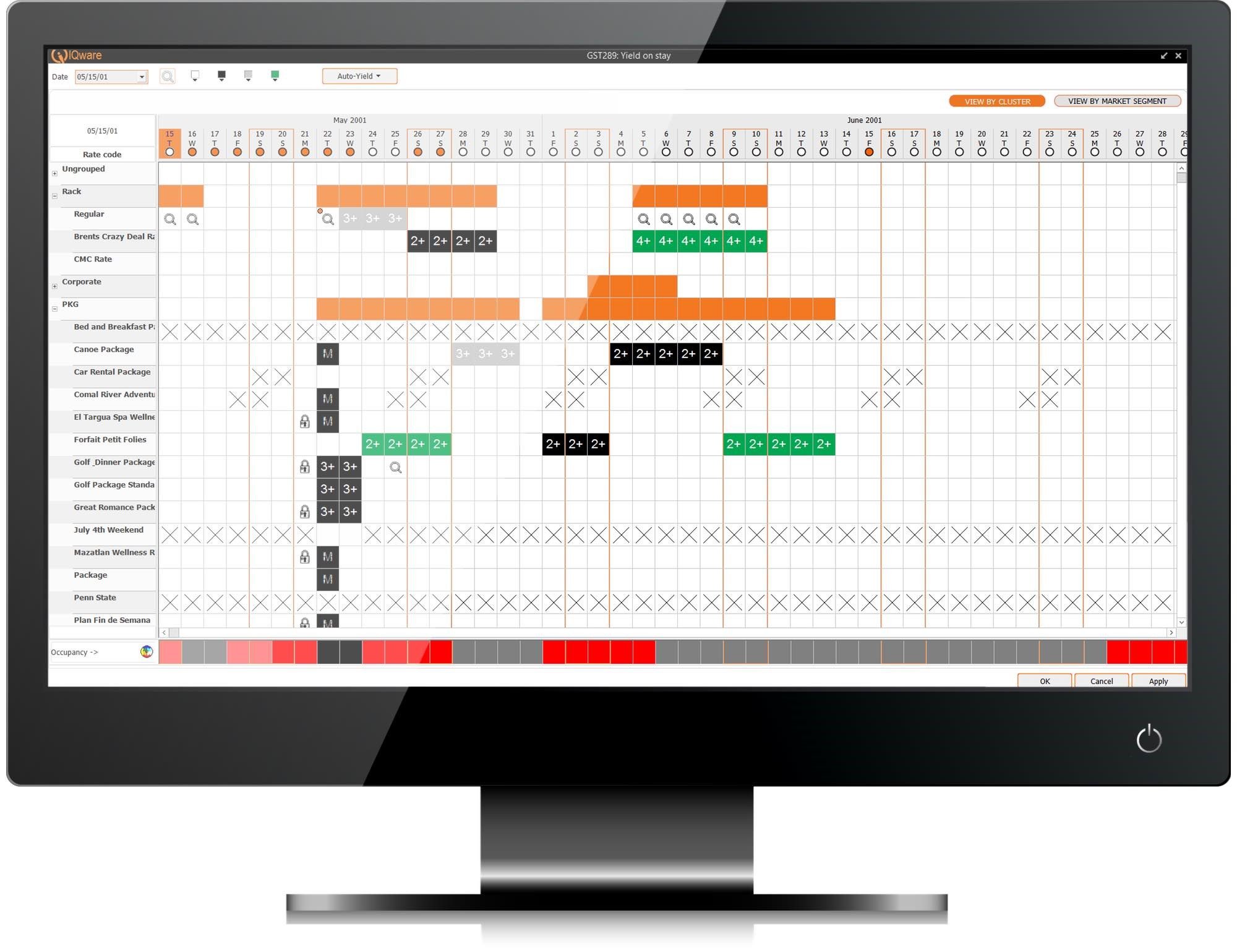
Interface of IQware PMS. Source: IQware
Channel management. Connection to multiple distribution channels is possible with the IQlink Channel Management Tool.
Revenue management. The revenue management module of IQpms has 5 levels of yield control. There’s also a rate management functionality that helps get the most yield out of occupancy levels, days, seasons, and events.
The optional modules that can expand the IQware PMS’s functionality are Activity Booking, Guest Loyalty Program, and Work Order Billing.
Additional IQware products that can be purchased separately are
-
Central Reservation System,
-
Email Platform,
-
Spa Management,
-
Point of Sale,
-
Sales and Catering, and others.
Modules for other property types include Timeshare Management, Vacation Club Management, Condo-Hotel Management, and Marina Management. They expand a standard list of features with functions like activity booking or a customized maintenance management module.
RMS PMS
RMS Cloud is an online all-in-one property management solution for hotels and resorts, as well as motels, holiday parks, campgrounds, and serviced apartments. It has an in-built channel manager, a booking engine, and a financial tools ecosystem for streamlined billing, invoicing, and reporting.
It also offers a guest portal that enables self-check-in, payments, and reservation adjustments, a housekeeping module, a POS system, and customizable business intelligence dashboards. The rate manager tool enables dynamic pricing and allows for accommodating long-term bookings.
RMS reviews highlight the ease of use and comprehensive functionality though some mention performance issues and lack of available integrations.
Systems for vacation rentals, apartments, guest houses, and lodging management
In our blog, we have a number of materials dedicated to managing vacation rentals (e.g., focused channel managers or specifics of alternative accommodation distribution). We’ve also discussed vacation rental PMSs in a dedicated article so you can consult it for a detailed overview.
In broad terms, a vacation rental PMS shares some structural similarities with a hotel PMS but omits modules such as sales and catering and traditional front-desk operations. Instead, the architecture prioritizes multi-channel distribution, communication, and mobile-first access for guests, owners, and operations teams. Vacation rental PMSs typically replace traditional housekeeping modules with task-based management, better suited for distributed properties, outsourced staff, and mobile-first workflows. Among other VR-specific features are:
-
a unified inbox (centralized messaging). Hotel PMSs typically send transactional emails (confirmation, pre-arrival). VR PMSs function like chat apps, accumulating chat threads from all distribution channels connected (Airbnb, Vrbo, Booking.com, etc) into a single view;
-
a unified calendar — a single, consolidated view of availability and bookings across all channels and properties;
-
smart locks that integrate with the PMS to automate guest access;
-
owner portal and trust accounting. A standard hotel PMS is built around the idea that the hotel retains all revenue. A vacation rental PMS, by contrast, operates on the premise that the money belongs to someone else — the homeowner. As a result, it must support owner logins and handle trust accounting — holding and allocating guest payments on behalf of multiple parties.
Some of the PMSs we discussed above provide vacation rental customizations. However, the hospitality technology market offers specialized products designed for alternative accommodation types.

PMS platforms to manage vacation rentals
Hostaway
Hostaway is an award-winning vacation rental PMS that automates all the daily operations including reservations, marketing, reporting, distribution management, and much more.
Hostaway offers a number of focused automation tools to streamline repetitive tasks related to payments, messaging, or reviews. There are also website building, payment processing, and other handy features included.
It comes pre-integrated with 100+ distribution channels and over 3,000 more integrations are available through Zapier. Users also reported great customer support.
Guesty
One of the most well-known solutions, Guesty is an all-in-one property management platform packed with all the standard features needed to run a vacation rental business with ease.
Guesty provides an exhaustive collection of standard features for property management, including a channel manager, multi-calendar, messaging, payment processing, and reporting tools. The system enables creating multiple user accounts with various access levels as well as handling all listing maintenance from a single dashboard. With Guesty, you can also build your own website and take advantage of a mobile application.
Your Guesty account can be easily synced with various booking channels, management platforms, and other services. These integrations can be found and activated on the provider marketplace. There’s also an open API you can use to connect other external tools and services.
Stays PMS
Stays PMS is a Brazilian product that features a channel management system with connections to more than 300 distribution channels, including Airbnb, Booking.com, Expedia, and HomeAway.
Stays PMS has a website management tool that integrates with Facebook and allows for content management. It also has a guest reviews tool, commission management, sales and marketing, and a payment processing tool. Depending on the number of accommodations (from 10 to 1000+), a customer can choose a suitable subscription plan.
What’s the future of hotel PMS?
Technologies in the hospitality industry are constantly developing, offering new functions and modules to optimize daily operations – and meet the newly emerging requirements related to global digitization. So what’s going on with them now?
API-first approach. As we already see, property management systems are switching towards cloud and open API platforms, which leads to a better connection between different modules and thereby sufficiently improves the speed and quality of data exchange.
AI-powered solutions. The hospitality industry actively adopts AI and Data Science to enhance performance and customer experience. Hotel property management systems become more AI-powered, especially in the fields of business intelligence, revenue management, and guest service (chatbots, e-concierges, assistants powered by LLM-based AI agents).
Internet of Things. We’ve already mentioned the increasing adoption of smart technologies (like in-room controls, facial recognition, etc.). Most of them are based on IoT connections and involve the implementation of sensors and other smart devices, all of which must be connected to the main hotel’s operational center – the PMS.