


If you want to sell hotel rooms via your travel website or app, you need to find the best fit out of multiple hotel API providers. We’ve done the groundwork to help you build your shortlist.
Drawing on our experience building travel technology solutions, we've explored 47 hotel API providers, from GDS and bedbanks to aggregators and giant OTAs, to help smaller OTAs, TMCs, tour operators, and other resellers navigate these challenges.
Here are five findings worth knowing before you make your choice.
- An API provider’s total portfolio isn’t your bookable inventory. Available inventory may differ from headline figures and can depend on the API product, enabled supplier connections, and your commercial agreement with the provider.
- Multi-product APIs reduce integration work. Nearly half of distribution providers advertise additional travel products, potentially supporting cross-selling through fewer integrations.
- To automate customer support, choose APIs that have post-booking capabilities. Of all 47 providers compared, 39 (83 percent) support booking, but only 32 (68 percent) explicitly list post-sale servicing. Of those, 17 (36 percent) offer broader post-booking capabilities, such as changing dates, guest details, and card information, plus reporting, while the other 15 (32 percent) support only cancellation.
- You might need to integrate a mapping platform to deduplicate content. Only 26 of 44 (59 percent) distribution providers report mapping capabilities. If they do, confirm whether they cover both properties and equivalent room types.
- If you are going to develop an AI agent (who isn’t?), prioritize API providers that offer an agentic layer. Just 7 of 47 providers (15 percent) advertise an official MCP server, with abilities ranging from documentation assistance to search, booking, and servicing.
These takeaways are just the starting point. We compared their hotel coverage, available content, booking and servicing capabilities, mapping functionality, API accessibility, and integration requirements. All findings are compiled into a downloadable datasheet.

Our comparison covers the main types of hotel APIs
Before we start the provider-by-provider breakdown, let’s take a quick look at how hotel distribution works and then walk through the criteria we use to compare hotel APIs.
How hotel distribution works and how to evaluate hotel APIs
Hotels distribute their rooms in two main ways. They sell directly to travelers through their own websites, apps, or front desks. Or they work with intermediaries (bear with us; we'll explain them below) that source hotel inventory and distribute it to travel agencies and other sellers.
Small and medium-sized travel agencies typically lack the resources to establish direct relationships with hundreds or thousands of individual properties. Instead, they rely on hotel APIs from intermediaries such as GDSs, bedbanks, and large OTAs to access inventory from multiple hotels via a single integration.

A slightly more complex view of the reality
By the way, we have an even more detailed infographic about hotel distribution, so check it out.
The good news is that there’s no shortage of hotel APIs to choose from, with providers catering to different business needs. But with so many options available, how do you find the right fit? To help you narrow down the choices, we’ll compare providers across several key features.
Сontent and functionality-related features
Let’s start with what each API actually delivers. The features below cover the core of the offering: where the inventory is located, how much of it you can access, what type of content is provided, and how deep the transaction capabilities go, from search to booking and post-sale management. Together, they define what you can build and sell on top of a given API.
Coverage indicates the countries and regions where a provider offers accommodation inventory. Most hotel API vendors in our comparison offer global coverage, although some have a stronger presence in particular regions, such as China and APAC, Europe, North America, or Latin America. However, global coverage doesn't mean equally extensive hotel inventory in every market. The actual selection of properties available through an API may vary depending on the supplier network, integration, and commercial agreements.
Inventory size refers to the number of accommodation properties a provider offers or connects to. In our comparison, 18 of 47 providers (38 percent) report portfolios of at least one million accommodation properties, excluding data-only platforms. The figures range from 12,000+ properties at Travco to 6 million+ at Agoda.

Figures are provider-advertised and may be platform-wide or API-accessible
However, these figures aren't always directly comparable. Some providers include apartments and alternative accommodations alongside hotels. Others report platform-wide inventory, which may differ significantly from what's accessible through their APIs. For example, Travelport advertises over 3 million properties across its platform, while its Stays API documentation cites approximately 140,000 properties worldwide.
The inventory actually available to an API customer may also depend on supplier connections and commercial agreements. Still, advertised figures give you a useful idea of each provider's scale.
Another factor worth checking is the number of directly contracted hotels versus third-party-sourced properties. Direct contracts can give you greater control over rates, availability, and booking conditions, potentially leading to more competitive offers and smoother servicing.
Other API-accessible products. If you're building a travel platform that sells more than accommodation, check what other travel verticals your potential API provider supports. It can reduce the number of integrations you need to build and maintain while also enabling cross-selling, bundled bookings, and dynamic packaging.

Multimodal APIs can reduce the number of integrations needed
Of the 44 hotel distribution and booking API providers in our comparison, 21 (48 percent) advertise products beyond accommodation. Flights are the most common additional vertical (13 providers), followed by tours and activities (12), car rentals and other vehicles (10), and transfers (10). Rail and travel insurance appear less frequently.
The degree of diversification also varies by provider type. All three GDSs cover additional travel verticals, compared with two-thirds of OTAs, 60 percent of aggregators and connectivity platforms, and 44 percent of bedbanks and wholesalers. Iween and Juniper offer the broadest range of additional verticals in our dataset, making them worth exploring for multi-product travel platforms.
Available transactions. Most hotel API providers in our comparison support the conventional search-and-book flow, also known as the pull model. Of the 44 providers analyzed, excluding data and mapping vendors, 39 (89 percent) offer booking capabilities.

Available transactions among distribution and booking APIs
However, post-booking functionality varies considerably. While 22 providers (50 percent) explicitly list broader servicing capabilities, 10 (23 percent) document cancellation without confirming other servicing functions. For another seven (16 percent), booking is supported, but servicing remains unverified.
Not all hotel APIs follow the pull model. Channel managers and connectivity platforms may instead push availability, rates, and inventory (ARI) updates to distributors and synchronize reservations with hotel systems. This approach serves a different purpose and does not represent a lower level of functionality.
Some providers support both push and pull models, combining inventory synchronization with real-time search, booking, and servicing. Examples include DerbySoft, Juniper, TravelgateX, RateGain, and SiteMinder.
Content type. Hotel APIs typically provide two types of content: static information, such as property descriptions, amenities, and images, and dynamic data, including rates, availability, and booking conditions.
In our comparison of 44 hotel distribution and booking API providers, all offer dynamic content, while 36 (82 percent) support both static and dynamic data. Another three provide limited or optional static content, and two have static content that remains unverified.
The differences are most noticeable among channel managers, whose APIs often prioritize exchanging rates and availability rather than delivering complete property profiles. Some support static data as an optional capability or through a separate integration.
Mapping capabilities. If a platform sources inventory directly from individual hotels, mapping is generally unnecessary. However, most hotel distribution platforms aggregate content from multiple third-party suppliers, where the same property may appear under different IDs. Mapping helps identify duplicates and consolidate hotel content.
Matching equivalent room types adds another layer of complexity, as suppliers often describe the same rooms differently.

How many distribution APIs report mapping capabilities
In our comparison, 26 of 44 hotel distribution and booking API providers (59 percent) report mapping capabilities. These are most frequently documented by aggregators and connectivity platforms (80 percent), followed by channel managers (71 percent) and bedbanks and wholesalers (56 percent). Among OTAs, only 33 percent explicitly mention them.
A lack of documentation doesn't necessarily mean mapping is unavailable, so it's worth confirming these capabilities with the provider.
Our datasheet also includes dedicated mapping providers, such as GIATA and Vervotech, which offer cross-platform hotel and room mapping services to reconcile content from multiple sources.
Integration-related details
Hotel inventory, content, and available transactions tell you what an API offers. But how easy is it to integrate? Access restrictions, documentation, data formats, and developer tools can significantly affect implementation timelines and costs.

Integration-related capabilities across 47 hotel API providers
Non-production API access determines how quickly you can start developing and testing an integration. We distinguish three access models:
- Self-service: Register on a developer portal and start working immediately, without manual approval.
- Approval-based: Submit an application for the provider to manually review your business. The process may take a few hours, several days, or longer.
- Contractual: Establish a commercial relationship with the provider before receiving development credentials.
In our comparison of 47 providers, 32 (68 percent) follow a contractual model, another 10 (21 percent) require approval or manual provisioning, and only 5 (11 percent) offer some form of self-service testing. The latter are Sabre, Hotelbeds, MakCorps, Nuitee, and TravelgateX, although access may be limited to certain APIs or test environments.
All six OTAs follow the contractual model, as do 14 of 18 bedbanks and wholesalers (78 percent).
Regardless of how easy it is to start testing, production access typically involves additional onboarding and acceptance of commercial terms.
Sandbox availability also affects development timelines, allowing engineers to test and troubleshoot integrations without making live bookings. Check whether the environment is publicly accessible, gated behind developer registration, or restricted to approved partners.
Only 7 of 47 providers (15 percent) list free testing options in our comparison. These range from dedicated sandboxes to limited trials and manually provisioned pre-production environments. For most other providers, availability or pricing remains undisclosed or depends on partner arrangements.
Integration stack and API documentation help developers evaluate compatibility, supported workflows, authentication, and implementation requirements. Documentation may be publicly accessible or restricted to registered developers and partners.
In our datasheet, 34 providers (72 percent) link to API documentation, though complete technical references may still be gated. JSON is listed for 68 percent of providers and XML for 45 percent, with some supporting both.
Developer tooling is less consistently advertised. 30 percent mention OpenAPI specifications, and 26 percent provide Postman collections or toolkits. Overall, 40 percent list at least one of these resources, while 15 percent offer both. Some providers also supply SDKs, code samples, or other utilities.
MCP server availability is worth considering if you're building AI-powered trip planners or booking assistants. An MCP server exposes selected API capabilities as standardized tools that AI agents can discover and invoke, potentially reducing custom integration work.
Only 7 of 47 providers (15 percent) in our comparison advertise official MCP offerings. However, these don't always support the specific hotel distribution APIs listed in our datasheet. Their functionality also varies, from hotel search, booking, and servicing to access to documentation and developer assistance. Some offerings are still being rolled out.
The criteria we described in this section apply to the whole market, but providers differ a lot in how they score on them. The next sections go through the main provider types and their best-known APIs, using the same lens: what they offer, how open they are, and what integration looks like.
Global distribution systems (GDSs)
This is the oldest middleman type. It originated in the airline industry and gradually sought to capture adjacent travel segments. Global distribution systems gather data from multiple sources, create their APIs, and distribute information to travel agents, OTAs, and travel management companies (TMCs). However, in hospitality, they won’t be the first option to look at.
What’s cool about GDSs? They boast a large inventory of hotels and other travel services worldwide. This means that, on paper, you can have a one-stop-shop experience with GDSs.
Whhat’s bad about GDSs? Integrating with a GDS may involve lengthy onboarding, complex procedures, and slower responses to technical or commercial requests. You may also encounter limitations in technology, inventory availability, and hotel content quality. Property descriptions, images, and other static content can be less comprehensive than those available through alternative distribution channels. Vacation rental inventory may also be more limited, making GDSs less suitable for platforms seeking a broad range of accommodation types.
Amadeus APIs: basic hotel support
Amadeus is one of the major GDSs with 2.3 million lodging options in its inventory. Since the Self-Service APIs were retired in July 2026, Amadeus offers a single connectivity option: Enterprise APIs, available as a set of legacy SOAP/XML and newer REST/JSON web services. The APIs are aimed at larger businesses, and if you are one, you should contact Amadeus directly and negotiate all conditions, including prices and request limits, with them. The services include:
- Hotel search and shopping
- Hotel booking and post-booking modifications
- Static and descriptive content retrieval, including individual property details (contacts, amenities, and policies).
Amadeus also brings hotel content from multiple sources into a unified booking environment, assigning unique hotel IDs to properties. While this suggests some level of internal standardization, the company doesn't publicly explain whether or how it identifies and maps duplicate properties across suppliers.
Integrating with Amadeus is no small feat, which is why it makes sense to check out our Amadeus integration guide based on our devs’ experience.
Sabre APIs: search by attributes
Sabre is another giant GDS on the market with 2 million properties. All connections and rates must be negotiated directly with Sabre representatives. But, unlike Amadeus, Sabre lets you experiment with some of its APIs without any prior negotiations: anyone can create an account in Sabre Dev Studio to obtain test credentials and access publicly available REST APIs in a sandbox environment.
Sabre offers 44 hotel APIs (both SOAP and REST) covering search, booking, servicing, and all types of content, including descriptions and images.
Find out how it feels to integrate Sabre APIs. By the way, AltexSoft is a Sabre Authorized Developer, so you know who to hire for integration.
The GDS also supports attribute-based shopping for hotel resellers. Their Content Services for Lodging (CSL) collection normalizes room and rate information across multiple suppliers, allowing travel sellers to compare offers based on attributes such as amenities, bed types, meal inclusions, and cancellation policies.


CSL handles internal hotel mapping, matching properties across its connected suppliers and assigning unified Global Property IDs. This helps prevent duplicate hotel listings and brings rates from different sources together under the same property, so resellers can compare offers without mapping Sabre's underlying inventory themselves.
Notably, Sabre became the first GDS to announce a proprietary MCP server with agentic APIs, starting with flights, hotels, and post-booking services.
Travelport TripServices Stays API: both GDS and non-GDS accommodations
Travelport is a large UK-based GDS that boasts over 3 million accommodation properties across its Travelport+ platform.
However, this figure shouldn't be confused with inventory accessible through its APIs. Travelport's API documentation cites approximately 140,000 properties worldwide, including content from third-party sources such as Booking.com.
Travelport has long provided access to its services through the SOAP/XML-based Universal API. In June 2026, it officially launched TripServices, a modern, cloud-native REST/JSON API platform for flights, hotels, and payments. A brand-new Stays API enables search, booking, modification, and cancellation, and provides access to rich content, including images, amenities, and policies. Post-servicing capabilities may vary by supplier.
Travelport is also developing an MCP-based interface for TripServices in collaboration with Cognizant and Anthropic. Meanwhile, Universal API remains supported, with migration guides available for developers moving to the new platform.
Like Amadeus, Travelport normalizes and enriches content from different sources. However, it doesn't explicitly confirm whether it performs hotel-level mapping and deduplication across suppliers.
Wholesalers or bed banks
A wholesaler (bed bank) sources hotel inventory at negotiated rates and resells it to travel agencies, OTAs, tour operators, and other travel businesses. Traditionally, wholesalers contracted blocks of rooms at fixed prices for a specific period. However, modern bed banks also work with dynamic pricing, often calculated as a discount from the hotel's best available rate (BAR), and may sell rooms without purchasing inventory upfront.
What’s cool about bed banks? Alongside GDSs, bed banks are the primary sources of hotel rooms for online travel agencies. Leading wholesalers like Hotelbeds offer quality customer service, modern APIs, and extensive inventory.
Why are bed banks… bad? Working with wholesalers can still mean lower margins. Another challenge is that bed banks don't necessarily contract directly with every hotel in their inventory. Many supplement their own agreements with rooms sourced from third-party suppliers, sometimes through multiple layers of intermediaries. This can lead to duplicate hotel listings, inconsistent rates and property information, and additional complexity when handling booking modifications, cancellations, or refunds.
If you want to dive deeper, check our bed banks overview.
Bonotel: exclusive luxury travel
Bonotel is primarily a tour operator offering wholesale access to luxury hotels, primarily across North America, with a growing presence in the UAE and other markets. So, its portfolio isn’t going to be large, but… well, pretty exclusive, if that’s what you’re looking for.
Bonotel offers an XML-based Direct API supporting:
- Hotel availability search and rates
- Pre-booking, reservations, and cancellations
- Static hotel content, including property and room details
Worth noting: At the moment, Bonotel is not accepting new partners via the website. You should talk to them in person at industry events. Check its website for updates, as this policy may change.
GRNconnect: unique lodging inventory
GRNconnect is the bedbank brand of India-based Aman Travels, with a global network of partners. It gives travel businesses access to over 500,000 hotels and 200,000+ apartments worldwide. Beyond traditional lodging, you'll find villas, chalets, palaces, houseboats, hostels, and private vacation homes.
GRNconnect aggregates inventory from over 80 suppliers and handles internal hotel mapping and deduplication, so the same property doesn't appear multiple times in search results. It also uses GIATA-powered room mapping to standardize room names and identifiers across suppliers, making it easier to compare equivalent room options.
Their RESTful JSON API also supports
- Real-time hotel search
- Booking, reservation retrieval, and cancellations
- Static hotel content, including property descriptions, amenities, and images
They also handle non-hotel products: around 200,000 tours and activities, 50,000 transfer options, and rail bookings.
Hotelbeds: the first place to go to for global coverage
Hotelbeds is one of the largest wholesale brands on the market, advertising API access to 300k hotels in 170 destination countries. (A nerd’s note here, there are 195 countries in the world.) They also connect 23,000+ in-destination experiences and 9,000 transfer routes.
Accordingly, Hotelbeds has three API suites, Hotel, Activities, and Transfers, all under the REST standard that support both JSON and XML exchange. Let’s see what the Hotel API suite offers.
Booking API provides room reservation capabilities, including:
- Flexible dates
- Availability check
- Booking, managing reservations, cancellations
Hotel Content API delivers standardized static hotel details that you can retrieve and periodically update in your system, including:
- Locations, countries, and destinations
- Rich content including property details, images, room facilities, bed types, and more
- Multilingual descriptions and reference data
Cache API is designed for businesses that need to process large volumes of inventory and pricing data locally, such as metasearch engines, price comparison platforms, and dynamic packaging providers. It supports:
- Downloadable snapshots of hotel inventory, prices, and availability
- Full and incremental data updates, with new files generated hourly
- Local caching and processing of large datasets for price comparison and package creation
Change Discovery Service (CDS) API tracks hotel inventory changes and recommends which hotels and offers to check for updates. This is particularly useful for large booking platforms that want to reduce unnecessary API requests and keep their availability and pricing data fresh.
If you combine Hotelbeds with other hotel APIs, you'll need to match property IDs to avoid duplicates. Hotelbeds' One Hotel Mapping platform automates this through its Crawler service, which matches partners' hotel catalogs against its inventory.
By the way, we have a whole article detailing Hotelbeds API integration, so make sure to read it too.
HPro Travel (HotelsPro): you’ll get content mapping in the bargain
HPro Travel (formerly HotelsPro) is another global wholesale provider that has connections (purportedly direct and indirect) with 1 million hotels in 70,000 destinations. HPro Travel has two main APIs that you may be interested in.
Coral API is a large pool of both contracted and third-party aggregated hotels through a RESTful JSON interface. What does Coral have?
- Hotel search
- Hotel booking
- Cancellations
- Alternative recommendations
Want to drill down into data?
Download the full report and analyze it your way.
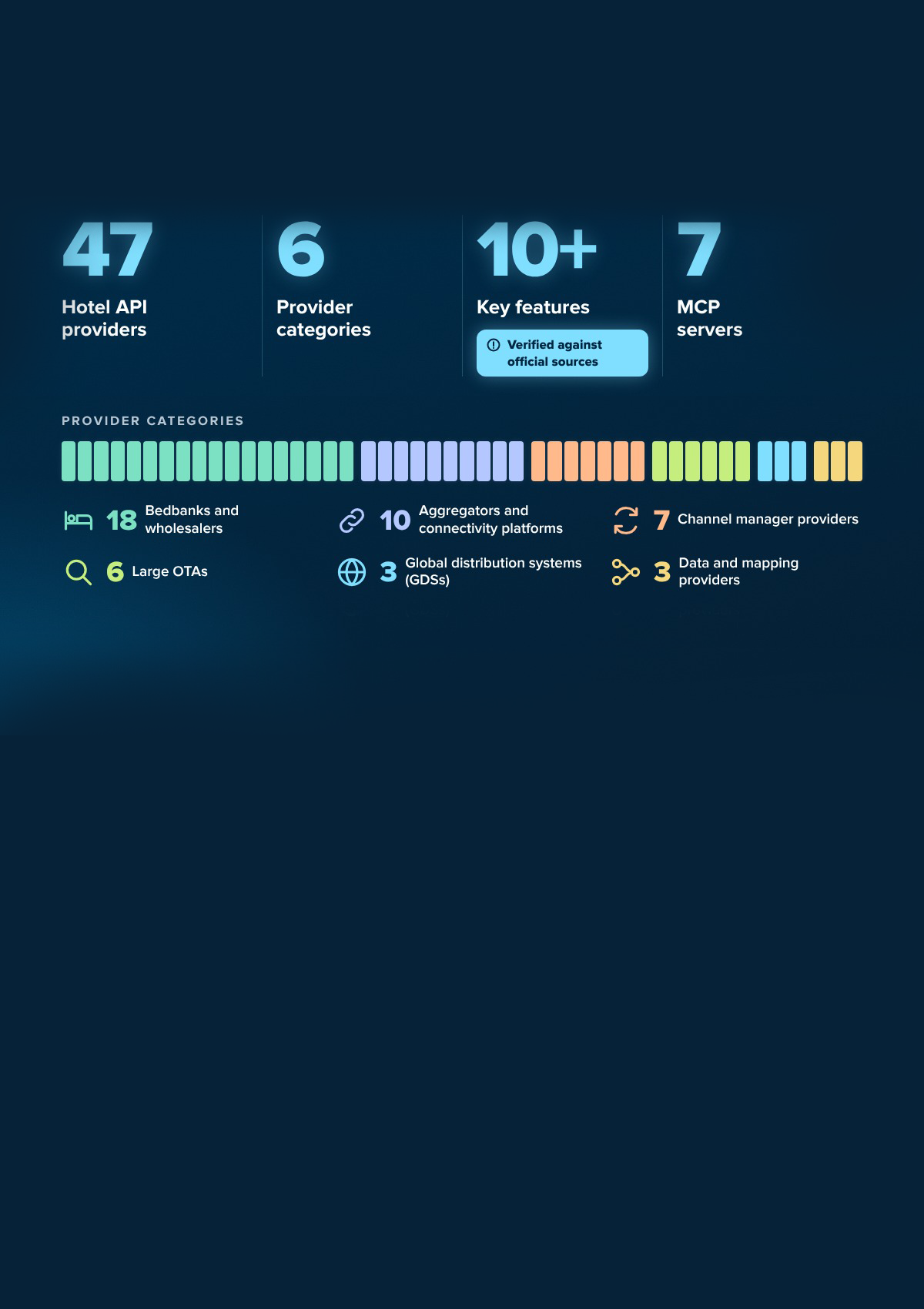
Okay, where's the static content? It’s supported by another API.
Cosmos API provides detailed information via JSON endpoints or downloadable files. It also handles internal deduplication, linking removed duplicate records to their surviving master hotel IDs.
Travco: Europe-focused wholesaler
Travco is an international hospitality business that originated in Egypt. It does almost everything in travel: aviation, tours, and even hotel construction. And they have a wholesale branch that specializes mostly in Europe. While they don’t claim to have hundreds of thousands of hotels, Travco features direct contracts with more than 12,000 hotels.
In terms of technology, Travco stick with good old XML. Its services include:
- Hotel search
- Hotel booking, modifications, and cancellations
- Rich content (photos, maps, descriptions)
- Multilingual support (9 languages)
- Packaged tours
- Exclusive contracted rates
Travco will send you handy newsletters about the latest developments, such as ownership and hotel changes or permanent and temporary closures.
WebBeds: the second place to go to and a great Asian coverage
The second largest bed bank is WebBeds. It claims to have about 500,000 properties in 39,000 destinations worldwide. While most of Hotelbeds’ inventory comes from direct agreements, WebBeds has such contracts with 98,000 properties. It also offers bookable access to over 21,000 ground travel services, including transfers and activities.


Its API capabilities cover:
- Hotel search
- Hotel booking, reservation management and cancellations
- Various accommodation types, such as resorts
- Multilingual support and rich hotel content
- Ground services
Content, property, and room mapping are also part of the API implementation process to ensure accurate search results and bookings.
Channel managers
A channel manager is software that most hotels would use. It helps them distribute inventory and rates across multiple channels simultaneously via a single interface. For example, once a room is booked on Expedia, a channel manager automatically notifies other online travel agencies that this room is no longer available. This helps hotels avoid manual work with multiple channels and prevent overbooking.

Obviously, there are many more channels usually available
But why are we even talking about channel managers? Well, if you’re an OTA, they may be an option to connect with their partner hotels.
As we said earlier, channel manager APIs typically work differently from conventional hotel booking APIs. They use a push model, sending availability, rates, and inventory (ARI) updates to your platform while accepting reservation details, modifications, and cancellations. This typically requires distributors to set up an API endpoint to process incoming updates, either in their own systems or through an integration partner. Hotels also usually need to enable your OTA as a distribution channel.
However, some providers also offer traditional search-and-book APIs alongside their push-based integrations. Where both models are available, we've marked it in our datasheet.
What’s cool about channel managers? They are ultimately technological firms that work directly with the hotels. You may expect that the rooms you source haven’t traveled through multiple third parties before they reach you.
Some channel managers also connect with vacation rentals and urban homes to distribute them through platforms like Airbnb, which makes them different from traditional GDSs and wholesalers. As you may know, wholesalers aren't likely to contract your grandma who rents out her bungalow for the summer.
What’s bad about channel managers? Their primary clients are hotels, not distributors, so securing an integration may require a strong business case. Your chances improve if a hotel or hotel chain wants to sell through your platform, though individual properties may still need to enable your channel.
The market is also fragmented. Hotels use different channel managers, and integrating multiple systems takes effort. Partnering with a few major providers and supplementing their inventory with wholesalers may be a practical solution.
Finally, some channel manager APIs don't provide static content. You may get rates and availability but have to source hotel images and descriptions separately.
We’ve chosen some of the largest channel manager providers, but keep in mind that there are many more out there.
Cloudbeds: ARI updates with optional static content
Cloudbeds is a large hospitality technology provider serving about 20,000 properties. Besides channel management, Cloudbeds offers a property management system, a booking engine, and REST APIs for hospitality technology partners.
Its OTA Build-To-Us API follows the push model described above, with a few specifics. Cloudbeds sends ARI updates and restrictions whenever they change and regularly polls the distributor for new reservations. Booking notifications can also be delivered through callbacks.
Static hotel content, including property descriptions, images, and room details, is available through the optional CreateProperty endpoint, which requires separate activation by Cloudbeds.
eRevMax: two-way XML connectivity
eRevMax is a hospitality technology provider best known for its RateTiger channel manager. Its portfolio also includes a booking engine, rate shopping tools, and hotel distribution solutions.
For OTAs and travel apps, the most relevant product is RTConnect, which provides two-way XML connectivity for exchanging rates, availability, reservations, modifications, and distribution restrictions. Over 20,000 properties use eRevMax's channel connections, although access to their inventory depends on individual hotel agreements.
Hotelbeds is one of RateTiger's long-standing connectivity partners, with a relationship dating back to at least 2007. The companies have also collaborated on occupancy-based pricing.
As for static content, RTConnect doesn't publicly document support for hotel descriptions, images, or amenities through its distributor connections. You'll need to confirm their availability with eRevMax or source them separately.
RateGain: access to 125,000 hotels via push and standard methods
RateGain is an Indian travel technology company offering a range of solutions for hotels and distributors, including channel management, booking engines, and revenue management tools. Its broader technology network covers over 200,000 hotel properties, while its travel-seller distribution platform advertises access to 125,000+ hotels.
RateGain offers two API integration models for travel resellers.
The Direct Connect – Demand (Push) API follows the traditional channel manager model, providing XML connectivity to properties that have enabled your platform as a distribution channel.
Meanwhile, the Smart Distribution API supports conventional hotel booking through REST/JSON requests. It also provides static hotel content, making it a more straightforward option for resellers looking for a complete reservation flow.
SiteMinder: three ways to integrate
SiteMinder is used by about 56,000 hotels, homes, and vacation rentals. That's more properties than some wholesalers offer.
For OTAs that have direct agreements with hotels, SiteMinder offers the SiteConnect API. It follows the ARI push model. Hotels must enable the OTA as a distribution partner before the integration can work.
For resellers looking to access hotel inventory without negotiating separate contracts with each property, SiteMinder also offers Channels Plus, which provides a conventional search-and-booking flow through a single REST/JSON API.
SiteMinder also offers a Channels Plus MCP Server, allowing OTAs to connect their AI-powered travel assistants directly to hotel search and booking capabilities.
Channels Plus requires a commercial agreement with SiteMinder. Hotels also retain control over their participation and available inventory, so not every SiteMinder property is necessarily accessible through the API or MCP.
Online travel agencies
OTAs occupy the pinnacle of the distribution pyramid. The world of travel is dominated by the two largest players: Booking Holdings (Booking.com, Kayak, Agoda, Priceline, etc.) and Expedia Group (Expedia, Travelocity, Orbitz, Vrbo, etc.) Because of their size, these behemoths can provide distribution support to smaller businesses (and, obviously, get a share of their markup).
Hotel chains, cozy local hoteliers, homeowners, and people with seaside bungalows willingly approach Booking and Expedia to distribute there, while the OTAs in turn suggest their own property management interfaces (extranets) for every hotelier to use.
What’s cool about connecting to big OTAs? They have almost everything, really. Remember 300k hotels at Hotelbeds? Well, Booking.com has more than 4.7 million listings. You also get full content and reservation support.
What’s bad about OTAs as a connectivity partner? If you plan to build a traditional OTA, using affiliate programs from your main competitors may be a viable option only in the beginning, as your partners will take a share of your booking markup.
Booking.com API: Choose your level of API integration
Booking.com, with approximately 4.7 million properties listed as of June 2026, has an affiliate program that offers several integration options beyond APIs, including links, search boxes, and other promotional tools. But its Demand API goes much further, covering not only accommodation but also car rentals and attractions, with transfer search currently in beta. Flights are on the roadmap.
The Demand API uses REST/JSON and offers several integration levels, allowing partners to choose how much of the booking journey they want to manage. They can access property content, search live availability, and redirect travelers to Booking.com to complete reservations—or enable customers to book and manage reservations directly on their own platforms. The API also supports different payment flows, financial reporting, and reconciliation.
Finally, Booking.com provides an MCP server that enables AI agents to access its supported travel-search capabilities. It requires affiliate credentials, and the available tools depend on the partner's configuration.

Expedia Partner Solutions (EPS): Access to 32 million property images
Expedia, the main rival of Booking Holdings, offers more than 3.5 million accommodation options across its brands, including Expedia, Hotels.com, and Vrbo.

Learn about Expedia’s grip over the travel industry in this video
Its RESTful Rapid API suite covers hotels, vacation rentals, car rentals, flights, and activities, although some products are still in early access.
So, what do they offer for hotel distribution?
- Live rates, availability, and booking conditions
- Rich content covering 800,000+ accommodations, with access to more than 32 million property images
- Booking, cancellations, and modifications
Another major OTA group worth looking at is Trip.com Group, which operates Ctrip, Trip.com, and Skyscanner. It also offers affiliate and distribution partnerships, although their integration capabilities vary by brand.

Aggregators and connectivity
Aggregators and connectivity platforms simplify access to hotel inventory from multiple sources through a single API. They handle integrations with bedbanks, wholesalers, hotel chains, and other suppliers.
However, their business models differ. Some act primarily as technical gateways, connecting you to suppliers you already have agreements with. Others combine aggregation technology with their own bookable inventory, allowing you to access hotel supply through a single commercial relationship. Some also offer booking engines and other travel technology solutions alongside their APIs.
So, what's cool about aggregators and connectivity providers? They can save you the effort of building and maintaining multiple supplier integrations.
What's bad about aggregators and connectivity providers? As we mentioned, not all of them own or contract the inventory they distribute. Some connect you to suppliers you must already have agreements with, while others provide access through their own commercial arrangements. Hotel content and rates can also pass through multiple intermediaries, making it harder to trace their source, maintain data accuracy, or resolve booking issues. And, of course, connecting through one API doesn't automatically mean that hotel content is deduplicated or standardized
Below, we'll take a closer look at some of these providers. You'll find more in our Hotel API datasheet. For a broader overview, check out our travel technology landscape infographic, featuring over 1,500 industry players.
DerbySoft: connectivity, AI-driven marketing solutions, and content
DerbySoft, acquired by Juniper Group (Constellation Software) in June 2026, is a US-based hotel connectivity provider whose network spans around 300,000 properties worldwide and over 1,000 integrations with industry partners. Its platform enables distributors to access inventory from multiple suppliers through a single API, supporting real-time rates, availability, and reservations.
Side note here: If you’re wondering where we get these numbers – it's right from the companies’ websites! Most of these businesses are private, so we have to trust their marketing numbers. Some public companies like Booking Holdings and Expedia expose inventory sizes in their annual reports, which appear more trustworthy than landing pages, but these are the only options we have.
Let's get back to DerbySoft. Its Exchange marketplace allows accommodation suppliers and distributors to work together under a single agreement, without negotiating separate contracts for each partnership.
Distributors access participating hotels through the GO Distributor API, which supports both push and pull integration models. With push, DerbySoft sends ARI updates to distributors, allowing them to maintain locally cached data. With pull, distributors request real-time rates and availability directly from DerbySoft.
Both models support reservations through a separate booking interface. Other capabilities include:
- Static hotel, room, and rate-plan content
- Booking, modifications, and cancellations
- Hotel ID, room, and rate-plan mapping
You can read our review of the main hotel content mapping tools on the market.
Gimmonix: distribution, mapping, and rate magic
Gimmonix is an Israeli-founded travel technology company operating since 2010. Its core product is the Hotel Sales Platform (HSP), which aggregates inventory from 250+ suppliers behind a single REST/JSON API.
HSP supports:
- Hotel search and booking across aggregated suppliers through a single API
- Built-in hotel and room mapping, plus content normalization
- Configurable business rules, such as blackouts, price overrides, and margin targets
- Post-booking processing, rebooking, and reporting
Gimmonix offers several other products that work alongside HSP or independently.
Mapping.Works allows OTAs and – surprisingly – hotels to cover hotel- and room-level mapping. OTAs can standardize the content they receive from various sources, while hotels can verify that their content is correctly mapped and displayed on distributor platforms. Unlike GIATA, which uses its own multicodes assigned to hotels and their content, Gimmonix has built a machine learning algorithm that automatically maps both on hotel and room levels.
RateFox is an AI-powered profit optimization service that compares equivalent room offers across suppliers to find better purchasing rates and improve distributor margins. It can also monitor confirmed bookings for price drops and automatically rebook at lower rates when booking conditions allow.
BI.Works is a business intelligence tool for pricing, insights, and hotel inventory analytics.
Juniper: booking engine with global connectivity
Juniper is a travel technology provider offering booking engines, connectivity platforms, and distribution hubs. Its portfolio includes over 1,000 integrations with travel suppliers across various product categories, including hotels, flights, car rentals, packages, transfers, insurance, cruises, and activities.
Juniper's XML-based Hotel API supports:
- Static hotel and room information
- Real-time availability and pricing
- Booking conditions
- Reservations and cancellations
Juniper also offers built-in hotel and room mapping to unify inventory from different suppliers and avoid duplicate listings.
In 2023, Juniper Group acquired Vervotech, an AI-powered accommodation mapping provider with a database covering over 3 million unique hotels and apartments. Its technology complements Juniper's existing mapping capabilities and is also available as a separate solution. We've included Vervotech's API in our datasheet.
Travelgate: huge marketplace with a single API
Travelgate, owned by French travel-tech company Travelsoft, is a marketplace that connects buyers and sellers under one platform. Its network includes over 1000 partners, such as leading bed banks, OTAs, direct hotel connections, and more.
Travelgate offers two buyer-facing APIs: Hotel-X Pull Buyers API and Channel-X Push Buyers API.
Hotel-X enables distributors to search and book inventory from connected suppliers on demand. It supports:
- Static hotel and room information
- Real-time availability, pricing, and booking
- Reservation retrieval, cancellations, and modifications, depending on supplier capabilities
- Hotel and room mapping, plus plugins for currency conversion, commissions, and other business rules
Channel-X, meanwhile, pushes availability, rates, and inventory updates directly to the buyer's system, reducing the need for repeated live searches. Bookings are still completed through Hotel-X.
Hotel-X uses GraphQL, allowing developers to request only the fields they need instead of receiving fixed responses. Channel-X, on the other hand, uses XML.
Xeni: white-label and mapping
Xeni is a travel-technology company that provides a white-label booking platform and API infrastructure for travel resellers. They have products for airlines, car rentals, and activities, but for our purposes, let’s focus on their hotel APIs, offering access to 2 million hotels and 28,000 resorts.
So what does their API support?
- Wholesale rates
- Booking
- Multi-language and multi-currency support
- Hotel and room mapping
Xeni is one of the few hotel API providers that provide access to a sandbox almost immediately, after a 15-minute setup call.
Data and mapping providers
Not all hotel APIs are about accessing bookable inventory. Some providers focus entirely on helping travel businesses manage the hotel data. These include mapping platforms that match property and room identifiers across suppliers, content services that send hotel descriptions and images, and pricing intelligence tools that compare rates from different sources.
What's cool about data and mapping providers? They help you make sense of hotel content coming from multiple APIs. Instead of showing the same hotel five times because five suppliers use different IDs, you can unify listings, standardize room types, and fill content gaps. Pricing data providers can also help you compare competing offers and monitor market rates.
What's bad about data and mapping providers? They don't have bookable inventory themselves, so you'll still need hotel suppliers and booking APIs. Plus, these services add another integration and, often, another subscription or usage fee.
Who uses data and mapping providers? Mainly OTAs, TMCs, tour operators, bedbanks, and hotel aggregators that combine content from multiple suppliers. Metasearch engines and hotel groups also use pricing intelligence services to compare rates and track competitors.
Let's look at three providers that solve different parts of this problem.
GIATA: One of the largest hotel mapping databases
GIATA is an old-timer in the hotel market, operating since 1996. Think of its database as a hotel directory where each property gets a unique GIATA-ID. Its MultiCodes product matches identifiers from different suppliers to that ID, helping distributors eliminate duplicate listings. Currently, GIATA reports around 1.45 million mapped properties worldwide.
GIATA offers several APIs, including two particularly relevant to hotel content and mapping.
The Open Content Link API is a RESTful API that supports JSON and XML responses and provides:
- Hotel master data
- Property images and room types
- Facts and amenities
- Multilingual texts
The MultiCodes API is GIATA's hotel mapping solution, using REST-style endpoints with XML responses. It links different supplier property codes to unique GIATA-IDs and provides:
- Property addresses and geocoordinates
- Phone numbers and other contact details
- Tour operator booking codes
- GDS/CRS property codes
- Hotel ratings and chain affiliations
- Nearby airports
GIATA also offers a separate Room Type Mapping service that matches and groups equivalent room types from different suppliers during live searches. Pretty useful, considering how much hotels love inventing unique names for their rooms.
MakCorps: Hotel pricing intelligence across OTAs
MakCorps collects pricing data from more than 200 OTAs, including Booking.com and Expedia, allowing travel businesses to compare rates across booking platforms.
Its Hotel Price APIs provide hotel rates by property or city, while the Room-Type API returns pricing for different room categories. MakCorps also offers historical hotel pricing data going back to 2010, useful for tracking price trends and analyzing competitors.
There's also a Hotel Mapping API, but its primary purpose is to match hotel names and locations to MakCorps' own identifiers for pricing queries, rather than serve as a full cross-supplier hotel deduplication solution.
In short, MakCorps is useful for price comparison, market research, and pricing intelligence, not for making hotel reservations.
Vervotech: Hotel and room mapping across suppliers
Vervotech specializes in hotel content mapping and standardization. Its Hotel Mapping and Room Mapping APIs address two related problems:
- Matching property records from different suppliers to identify the same hotel and assign consistent identifiers.
- Grouping equivalent room offers from different suppliers using attributes such as bed types, views, and amenities.
Like GIATA, Vervotech doesn't act as a conventional hotel inventory supplier. Its value lies in helping travel businesses organize and standardize the content they get from their existing booking APIs.
AI-first hotel aggregators
A new type of intermediary is worth noting, even though AI-native hotel aggregators don't offer conventional booking APIs for resellers and, as a result, aren't included in our datasheet. They aggregate hotel content, rates, and availability and make this information available to AI assistants and agents through MCP servers. The goal is to drive direct bookings: Travelers can compare hotels in the conversation and then follow a link to the hotel's website to complete their reservation.
One such aggregator, Connect AI by Lighthouse, focuses on integrations with general-purpose AI assistants, with no publicly documented API for OTAs or independent travel apps.
DirectBooker, meanwhile, offers commercial partnerships for search, metasearch, and AI platforms. It covers approximately 1 million properties worldwide, sourcing hotel information and rates directly from hotel groups, through connectivity providers, and from publicly available sources. DirectBooker also reports agreements with six of the world's ten largest hotel groups, including BWH Hotels and Radisson Hotel Group.
Through MCP, partner platforms can retrieve hotel content, rates, availability, and direct-booking links. These capabilities are already available to travelers through DirectBooker's integrations with ChatGPT and Claude. For search and map platforms, the company also supports standard hotel price feeds.

Oleksandr is a content strategist and editor. He leads (when possible) the team of independent-thinking writers and tech journalists at AltexSoft. With over 10 years of writing and editing tech-related pieces and scripts, he currently focuses on travel tech, data science, and AI. Outside of work, Oleksandr enjoys escapism in video games and game development.

Olga is a tech journalist at AltexSoft, specializing in travel technologies. With over 25 years of experience in journalism, she began her career writing travel articles for glossy magazines before advancing to editor-in-chief of a specialized media outlet focused on science and travel. Her diverse background also includes roles as a QA specialist and tech writer.
Want to write an article for our blog? Read our requirements and guidelines to become a contributor.