Frontier Swings to Q4 Profit, Targets 2026 Turnaround Through Fleet Cuts
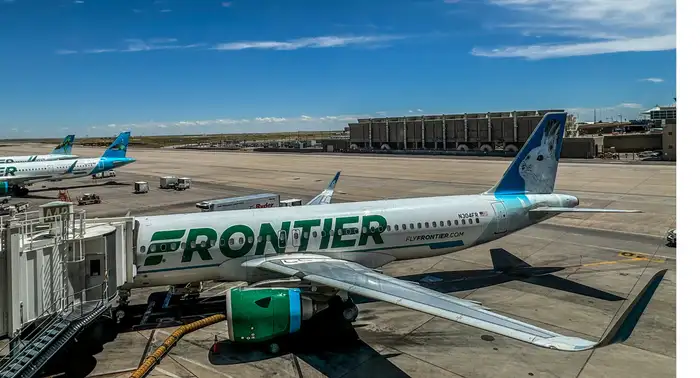
Frontier said it finished the fourth quarter 2025 with revenue that held steady year over year, while still producing a profit, helped by changes in revenue management and a more balanced supply-demand environment as the quarter progressed.
Fourth quarter 2025 financial results
- Total revenue was $997 million, (down 0.5 percent) from $1.002 billion in 2024
- Net income was $53 million (down 1.9 percent) from $54 million
- RASM (Revenue per Available Seat Mile): 10.17 cents (down 0.6 percent) from 10.23 cents
- Costs: CASM: 9.67 cents (down 1.1 percent) from 9.78 cents
- Fuel price (avg per gallon): $2.44 (down 1.6 percent) from $2.48
Management said results came in above guidance, despite disruption tied to an extended US government shutdown earlier in the quarter.
Full year 2025 financial results
For the full year, Frontier’s top line dipped slightly, and the company posted a net loss, showing how sensitive ultra-low-cost carriers can be when demand, costs, and competition move even a little in the wrong direction across a full year, even if one quarter finishes stronger.
- Total operating revenue: $3.724 billion (down 1.4 percent) from $3.775 billion
- Net loss: $137 million (worse: swung from +$85M to a loss)
- Diluted EPS: -$0.60 (worse: swung from +$0.37 to a loss)
- Total operating expenses: $3.873 billion (up 4.2 percent) from $3.717 billion
- Liquidity (year-end): $874 million (down 6.5 percent) from $935 million
Strategic initiatives and key milestones of 2025
Frontier’s strategy is essentially: protect liquidity, right-size capacity growth, and improve revenue quality (not just volume). That matters for the wider travel industry because capacity discipline from low-fare carriers can ease fare pressure in competitive markets, while new routes still stimulate demand in leisure-heavy destinations.
- Fleet actions: a non-binding deal with AerCap to early return 24 A320neo aircraft in the second quarter of 2026, plus 10 future sale-leasebacks tied to 2028–2029 deliveries.
- Orderbook pacing: a non-binding framework with Airbus to defer 69 A320neo-family deliveries originally scheduled for 2027–2030 (pushing them to 2031–2033).
- Network growth: 23 new routes launching in March/April, plus 57 routes that launched in late 2025 and early 2026 (US and Mexico).
- Management’s operating priorities: fewer cancellations, better on-time performance, tighter cost discipline, and a more mature loyalty approach—areas that directly affect passenger experience and reliability.
2026 outlook and growth expectations
Frontier’s guidance shows both caution and opportunity: the range is wide, but the company explicitly says profitability is achievable if cost actions and demand trends align. For travelers, this kind of plan often translates into measured capacity growth (fewer “too many seats” situations) and more focus on operational reliability.
- Full-year 2026 adjusted diluted EPS guidance: loss of $0.40 to profit of $0.50 per share (midpoint implies a small profit).
- First quarter of 2026 adjusted diluted EPS guidance: loss of $0.26 to $0.44 per share.
- Capacity growth: about 10 percent for full-year 2026 (management also ties this to a more “measured” long-term growth profile).
- Targeted cost impact: fleet changes and other initiatives are aimed at $200 million in annual run-rate cost savings by 2027.
The real test now is execution. Frontier says it will confirm its fleet and cost plan in Q1 2026, then start returning 24 A320neo jets in Q2 2026. These steps are meant to reduce the “too much capacity” issue and slow growth to a steadier pace.
Watch AltexSoft’s video on Spirit Airlines and the ULCC model to learn more about the segment and its vulnerabilities.
Photo by Michael Evans on Unsplash
Hot News
Tripadvisor’s 2025 Results Say Experiences Bring 30% of Profit

Frontier Swings to Q4 Profit, Targets 2026 Turnaround Through Fleet Cuts

Southwest Adds Starlink WiFi to Match “Home-Like” Speeds

Marriott Grows Q4 2025 Revenue, Signals Steady 2026 Upside From Fees
