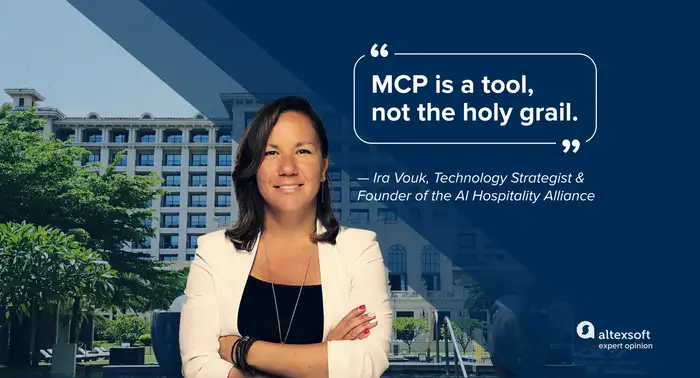
Ira Vouk, Founder of the AI Hospitality Alliance: “MCP Is a Tool, Not the Holy Grail”
With GenAI reshaping the travel landscape, a key question is whether hotel infrastructure is ready for this shift — and to what extent frameworks like the Model Context Protocol (MCP) and the Universal Commerce Protocol (UCP) can accelerate the move from legacy systems to agentic distribution.
In an interview with AltexSoft, Ira Vouk, Technology Strategist and Founder of the AI Hospitality Alliance, looks past the hype to assess what these approaches can realistically solve today and where the real gaps remain.
Q: MCP is increasingly discussed as a potential fix for many hospitality issues. What can it realistically solve today?
Ira: MCP is just a protocol, a recommendation for how to let LLM access and read information from different data sources without glitching much. But if you build MCP, then what? LLM won’t magically start seeing your content. You still have to connect to AI platforms to reach the end consumer and teach LLMs how to understand your data properly. It’s a tool, not the “Holy Grail”.
Q: One of the key promises of MCP is addressing the fragmentation problem…
Ira: Our industry has been trying to fix standardization issues for 25 years. HTNG (Hospitality Technology Next Generation) was the first official organization launched for this mission in 2002. And we’re still not there. The reason is not that we’re not trying hard enough, or don’t have enough brains or tools. The reason is the nature of our industry, which is fragmented, with hotel companies running their businesses in many different ways.
That is not going to change, because out of 1.3 million hotels in the world, 1 million or more are independent. Many small business operators are owners who never read a book on how to run a hotel when they buy or inherit one. They don’t know what HTNG even means.
The fragmentation isn't just on the hotel side; it’s on the tech side too. You have tons of startups that cater to these different business types, forms, segments, service levels, and sizes. So any attempt to force a standard by default won't be embraced. No single standard can address the variety of use cases that exist in our industry.
Is MCP going to help us? Probably. Maybe it’ll make it a little easier to integrate things. Because it seems not to be very difficult to build an MCP server and then create an app with ChatGPT. You need far fewer resources than for a standard integration with an on-prem PMS, for example. But when we talk about MCP and agentic bookings, there are at least three scenarios that require very different approaches and tech stacks.
Q: What do those scenarios look like in practice? Can you walk us through them in more detail?
Ira: The first is an AI-assisted scenario. It’s when the user is interacting with a tool like ChatGPT, browsing hotel options, and then completing the booking by clicking through to the hotel’s website.
The second is AI-moderated. The AI chatbot is embedded directly into the hotel’s own website, which is already becoming quite common. The hotel controls what’s exposed, and the interaction stays within its own ecosystem.
And the third one is AI-executed, where my agent talks to the hotel agent and books the transaction—all without manual involvement. It raises the biggest questions about identity, trust, payments, who is doing what, who owns the transaction, and who is the merchant of record. This model is not yet operating at scale, largely because we haven’t solved its core issues yet.
For context, OpenAI announced that they’re pivoting away from addressing processes like booking transactions — they’ll be a discovery layer only. Google is the only platform with a solid product for our industry, but it’s not using MCP.
Q: Will agentic AI distribution finally reduce the dominance of OTAs or even replace them?
Ira: Nothing is going to fully remove OTAs from the game. They’re very powerful, with huge budgets, and they’re not going anywhere — whether we like it or not. But we had very high hopes for MCP when it was announced, as it was expected to allow hotels to regain some control over the booking process and distribution channels. Yet, as I mentioned, MCP is just a tool. The real question is how we use it — or whether we use it at all. Right now, most hotels aren’t using it at all.
When OpenAI launched OTA apps rather than hotel apps, it was quite frightening. I’ve long pushed for helping AI platforms better understand hospitality, but those efforts didn’t gain traction. The reality is simple: Booking.com and Expedia offer centralized inventory, which makes integration easier and delivers what users actually want — choice. People don’t want to browse hotels one at a time; they want a database they can compare, filter, and sort.
That’s why I created the AI Hospitality Alliance — an independent platform focused on AI in the industry. It brings together hoteliers, tech vendors, academics, and investors, not OTAs. A large part of it is taking back some control from OTAs, especially as new intermediaries emerge. The technology is already there — it just needs industry alignment.
Q: How are these new intermediaries supposed to work, and aren’t they basically just a new kind of OTA?
Ira: Well, they’re still intermediaries — but with a different, potentially fairer model. An AI platform connects to a single aggregator that consolidates direct booking inventory, then redirects demand to hotel websites for a modest commission. The key difference is that hotels remain the merchant of record and keep all customer data — communication, profiles, even just the email address — which OTAs don’t provide today.
What’s interesting is that these aggregators will proactively onboard hotels instead of waiting for them. Even unconnected hotels would still appear. For example, one platform claims it can show 1.3 million hotels, even if only 10,000 are connected. But those that are connected — especially with an MCP layer — would get better visibility, fewer glitches, and more accurate, real-time data.
I support this model — it could solve many industry problems. But since it’s still a third-party provider, hotels often see it as just another cost. And as an industry, we’re slow to move. I’m hoping the alliance I’m building can help push things forward — at least by raising awareness and starting the conversation.
Q: If agentic search and booking take off, who will be in charge of operations, such as post-booking communication?
Ira: It should be the hotel. Whether the process is AI-assisted, AI-moderated, or fully AI-executed, the hotel needs to own the booking, the dialogue, and the overall experience. That won’t be true in every case — OTAs will still exist — but in an MCP-driven, agentic model, the hotel should remain the merchant of record. The guest receives the hotel’s confirmation number, and communication happens directly with the hotel, while the intermediary simply facilitates the transaction.
Q: How does UCP fit into the ecosystem?
Ira: UCP is the commerce layer, serving a different role than MCP. MCP handles discovery, while UCP comes in when the booking happens — covering payments and data exchange inside an AI chat. There’s also a similar effort from OpenAI and Stripe called ACP — Agentic Commerce Protocol. It’s essentially their answer to UCP. But adoption is limited, partly because, as I mentioned, OpenAI has stepped back from focusing on the transaction layer for now.
Q: Studies show that only a small fraction of travelers are ready to complete bookings with AI agents. How can the industry address this lack of trust?
Ira: I wouldn’t draw too many conclusions from what consumers say right now. Henry Ford didn’t ask people how fast they wanted horses — he built a car. The same applies here: when AI booking becomes seamless, people will just start using it naturally.
Right now, AI has a trust problem — hallucinations, security concerns, especially in Europe where privacy sensitivity is higher. So if you ask consumers directly, the response will skew negative.
But behavior is already shifting. Platforms like Perplexity support booking, and the transaction layer isn’t new — payments are handled by existing systems like Stripe. AI’s role is discovery, not execution. What will change is how seamless the experience becomes — keeping everything inside one interface. It’s still messy today, but that will improve.
Q: If a hotel wants to be present in AI booking channels today, where should it start?
Ira: For independent hotels, start with your distribution provider. Ask about their plans for AI discoverability and MCP. If they don’t have an answer, it may be time to reconsider the provider.
For larger hotel groups, check both your CRS and booking engine. It’s not just about discovery — your systems must support seamless booking by AI agents. If agents get blocked or confused, they’ll default to OTAs like Expedia.
Next, consider implementing MCP in your own environment, on your website, so users can both discover and book directly. It’s not overly complex, but it requires proper testing, security, and guardrails around it.
Also, look at emerging aggregators connecting hotels to AI platforms. Some already have apps in ChatGPT. It’s worth exploring and experimenting — the winning model isn’t clear yet, but aggregators could offer a more direct path.
Q: Will MCP and UCP become a standard layer in the hotel tech stack in the next few years?
Ira: In an ideal world, we’d have a standard MCP layer for discovery and a UCP layer for transactions, both tailored to hotels. But in reality, not all hoteliers will adopt them, and some will build their own solutions anyway. So it’s better to think of them as recommendations — a starting point that outlines the key stages.
The real challenge isn’t creating standards — it’s driving adoption, especially across hundreds of thousands of independent hotels. We’ve seen this before with HTNG: some companies adopted its API standards, others found them too limiting. The same will happen here.
Google has made the most progress, connecting around 1.2 million properties through Google Hotels — not via MCP, but through years of integration work, now enhanced with AI. What the industry needs is a similar approach for direct bookings. If that happens, it could improve profitability for hotels and deliver a better experience for travelers.