Southwest is Now Charging for Seats. But Why?
What happened?
On January 27, 2026, Southwest ended its long-time practice of letting passengers choose any open seat after boarding and switched to assigned seating, where each traveler gets a seat number in advance. It is one of the biggest product changes in the airline’s history.
The shift marks a new era for a carrier that kept the same boarding-and-seating model for decades, and it sets up Southwest to sell seat choices and new upgrade options in a way it largely avoided in the past.
What did Southwest’s “open seating” mean?
Open seating meant Southwest did not assign seats in advance.
Passengers boarded in order and picked any open seat, so where you sat mostly depended on how early you boarded.
What does assigned seating mean? Must travelers pay for seats?
Assigned seating means you get a seat number before boarding instead of choosing any open seat after you get on the plane.
Some seat choices are included in your fare, while others may cost extra depending on the seat type and what fare you bought. That should make seating more predictable and reduce the rush to board early for a better seat.
How does Southwest seating work now?
Southwest’s cabin is still “one cabin,” but seating is now sold in three categories:
- Standard seats (standard legroom, generally toward the back)
- Preferred seats (standard legroom, closer to the front)
- Extra Legroom seats (more pitch, generally at the front and near exit rows, with “up to five” extra inches depending on aircraft)
Southwest does not list one fixed price for each seat type. Instead, the difference mostly depends on what your fare includes and whether you want to pay extra for a better seat if one is still available.
- Basic fares get a Standard seat assigned at check-in.
- Choice fares can pick a Standard seat at booking.
- Choice Preferred includes a Preferred seat.
- Choice Extra includes an Extra Legroom seat.
Travelers on lower fares can also pay extra for Preferred or Extra Legroom seats if available, but the airline does not list one fixed price for those upgrades.
In other words, seat choice at Southwest is now shaped more by price, fare type, and availability than by how early you board.
How does Southwest boarding work now?
Southwest introduced boarding groups. They define how early passengers can board the plane. For example, boarding Group 1 goes first, Group 2 goes second, and so on. Southwest says it now has eight such groups.
- Extra Legroom passengers board in Groups 1 and 2.
- Preferred-seat passengers board no later than Group 5.
- Choice and Basic travelers usually board later, with Basic listed as last to board, although Southwest says some Choice and Basic passengers may still board earlier. But the airline does not explain the exception in detail.
- A-List Preferred members board no later than Group 2.
- A-List members board no later than Group 5.
Southwest also says travelers will be able to buy Priority Boarding starting 24 hours before departure if they want to be among the first to board.
Why did Southwest make this change?
Southwest says the change is part of a transformation meant to give travelers more choice and control. In reality, the move must support the airline’s profitability.
This change also reflects a broader airline industry trend. Carriers are increasingly trying to earn more from add-ons such as seat selection, extra legroom, baggage, priority boarding, and Wi-Fi, rather than relying only on the base ticket price.
Low-cost carriers such as Ryanair built their model around charging separately for extras like baggage, priority boarding, and seat selection. Full-service carriers moved in the same direction over time: American Airlines began charging for the first checked bag in 2008, and United later showed how valuable seat fees can become, collecting $1.3 billion from seat selection in 2023.
Ancillary revenue is now a major part of airline economics. It reached about $150 billion worldwide in 2024, or roughly 15 percent of total airline revenue. The share is especially high at ultra-low-cost carriers, including 62 percent at Frontier, 58.7 percent at Spirit, and 52.9 percent at Allegiant. At large full-service airlines, the share is lower — 18.6 percent at United, 17 percent at American, and 16.8 percent at Delta — but the total sums are still measured in billions of dollars.
Have other airlines made similar moves before?
Yes. Other low-cost airlines have already moved in this direction. Ryanair has long used an unbundled fare model, where the base ticket excludes extras such as seat selection, baggage, and priority boarding, and passengers can either pay for a reserved seat or accept a random one at check-in.
easyJet also sells paid seat selection, including Up Front and Extra Legroom seats, alongside bundled fare products.
In the US, Frontier has built much of its model around charging separately for services such as seat selection, carry-on bags, and priority boarding, while also adding products such as BizFare and new First Class seating.
The revenue impact is significant. Ancillary revenue accounted for 32.0 percent of Ryanair Group’s total revenue and 36.1 percent of easyJet’s in the latest published rankings, while Frontier reached about 62 percent in 2024, one of the highest shares in the industry.
Does Southwest still let bags fly free?
Not for most travelers.
Southwest now charges $35 for the first checked bag and $45 for the second on many fares, while some higher bundles, elite members, and certain cardholders still receive free checked-bag benefits.
Are there any other changes?
Yes.
Southwest has announced it will bring Starlink onboard, saying the first equipped aircraft will enter service in summer 2026 and that it aims for more than 300 aircraft by the end of 2026.
The airline has also confirmed that it is considering a first-class-style product as part of its broader transformation.
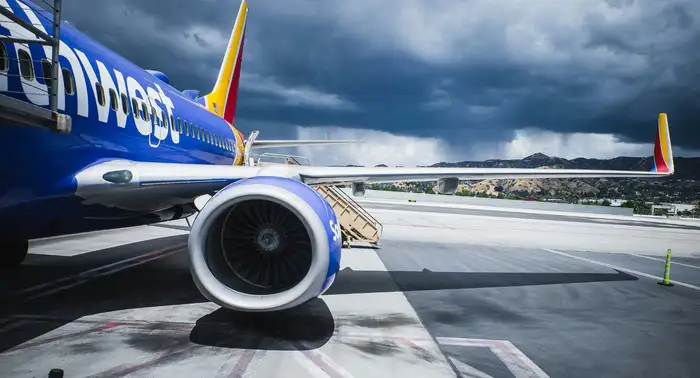
Photo by Owen Lystrup on Unsplash