Qantas Reported Higher Profit, Shares Fell as US Route Demand Softened
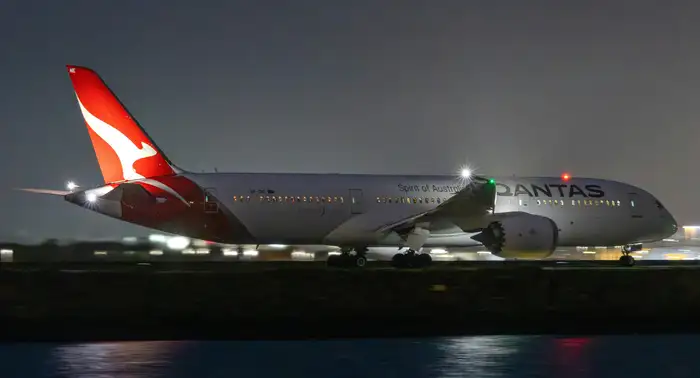
Qantas, an Australian flag carrier, reported its first-half FY2026 results.
The airline posted a strong headline result, with underlying profit before tax rising 5 percent to A$1.46 billion (US$1.04 billion). Underlying earnings per share increased 7 percent to 68 Australian cents (US$0.48), and the group maintained a 12.3 percent operating margin.
How Qantas performed compared with the same half last year
Compared with the same half last year, the changes were solid but not dramatic.
- Underlying profit before tax increased from A$1.385 billion (US$0.99 billion) in 1H25 to A$1.46 billion (US$1.04 billion) in 1H26, a rise of A$71 million (US$50.6 million).
- Statutory profit after tax was broadly flat at A$925 million (US$659.7 million) versus A$923 million (US$658.3 million) a year earlier.
- Underlying earnings per share rose from 63 Australian cents (US$0.45) to 68 Australian cents (US$0.48).
- Group operating margin edged down slightly from 12.4 percent to 12.3 percent.
However, investors focused on weaker areas in the report. Qantas shares fell after the announcement because the market was concerned about softer demand on some US routes and rising costs in the international business.
Why this matters for the travel industry
This result is important because it shows a wider trend in travel: demand is still strong, but it is uneven. Some parts of the market, such as domestic travel and premium segments, are holding up well. Other areas, especially some long-haul economy routes, are showing more pressure.
For airlines and travel companies, this means route performance matters more than ever. Strong overall demand is not enough if key international routes become weaker or more expensive to operate.
What helped Qantas and what created pressure
Qantas’ results were supported by strong domestic performance, better Jetstar earnings, and progress in fleet renewal. The company also benefited from capacity growth and lower fuel pressure compared with earlier periods.
At the same time, international earnings faced pressure from higher engineering, labor, and training costs. Qantas also said demand from Australia to the US in economy cabins was weaker, and stronger demand in the other direction did not fully offset that weakness. This was a major reason investors reacted negatively.
What comes next
Qantas says it sees the weakness on US routes as a short-term issue and remains confident about the second half. Investors will now watch upcoming updates closely to see whether international demand improves and whether margins stabilize.
The company still has strong foundations, but the next few months will be important. If Qantas can manage costs and improve international route performance, market confidence may recover.
Qantas’ next steps should also be viewed in the context of its wider network strategy, not only US route performance. Qantas expanded its reach through a bilateral codeshare with Malaysia Airlines, adding more connection options across Malaysia and parts of Australia through the oneworld network. That move supports a broader strategy of strengthening regional connectivity and diversifying traffic flows while the airline manages softer demand on some long-haul routes.
Hot News
Delta Buys Spirit Gates as Atlanta Rivals Run Out of Room

Bolt Targets Messy Ride Expenses With New Employee-Pay Mode

FAA Eyes AI for Air Traffic Safety as Runway Risks Keep Rising

TPConnects Launches Iris Express API to Cut NDC Complexity
