Middle East Skies Under Conflict—What’s Safe and What’s Risky Now
What happened?
On March 16, a drone-related incident near Dubai International Airport caused a fire and temporarily stopped flights. The timing mattered. Airlines were still trying to restore flights after earlier disruption caused by the conflict involving Iran, Israel, and the US.
Airlines across the Middle East are still dealing with changing airspace risks, last-minute schedule changes, and route suspensions. For example, British Airways has extended flight cuts in the region, and KLM has canceled Dubai flights until March 28. Air France and Lufthansa Group carriers have also extended suspensions or reduced service on some Middle East routes.
Why are travelers asking if it’s still safe?
Because travel has become unstable. Earlier this month, thousands of flights in, out of, and across the Middle East were canceled. More than 1 million passengers were affected. Airlines also started rerouting flights to avoid higher-risk airspace. That makes trips longer and less predictable.
That leaves travelers with a simple question: is it still safe to fly, especially through major Middle East hubs such as Dubai, Doha, and Abu Dhabi?
Is it safe to fly in the Middle East right now?
In many cases, yes—if your flight is operating. Airlines do not fly “freely” through active conflict areas. When military activity increases risk, flights are rerouted or paused, and airlines follow official restrictions and safety guidance. The risk is not zero, but routes that continue to operate are generally planned to reduce exposure.
For most travelers, the bigger issue right now is disruption, not a complete shutdown. Airspace rules can change fast, which can lead to cancellations, longer routes, diversions, and missed connections. That is why it’s smart to build extra buffer time and treat airline updates as the most reliable source for your specific route.
What is the real risk for travelers—safety or disruption?
For most travelers, the real problem is disruption, which can look like:
- Your flight is delayed because it has to take a longer route
- Your aircraft is diverted to another airport
- You miss your connection because the hub slows down
- Your flight is canceled at the last minute because the route is paused
Which countries’ airspace is affected right now?
Airspace across Bahrain, Iran, Iraq, Israel, Jordan, Kuwait, Lebanon, Oman, Qatar, the United Arab Emirates, and Saudi Arabia’s Jeddah flight region. EASA classifies that affected airspace as high risk and recommends operators avoid it at all flight levels and altitudes.
That is why airlines often make route-by-route decisions: they reroute some flights and suspend others. It depends on where the aircraft is going and what corridors are open that day.
Is it safe to fly over the Middle East if I’m not landing there?
Sometimes yes, but it depends on the route your airline uses that day. Airlines may avoid certain corridors, reroute around specific countries, or fly farther north or south than usual to stay away from higher-risk airspace.
So even if your flight is still operating, it may take longer and be more likely to face delays—or, in some cases, a diversion—because the route has changed.
Are flights to Dubai (DXB) operating normally?
Not always. When Dubai is disrupted, the impact spreads fast because it is a major global connection hub. A drone-related incident near Dubai International Airport caused a temporary halt and rerouting of flights, with operations gradually resuming afterward.
When DXB is disrupted, the impact spreads far beyond the UAE.
Is it safe to transit through Dubai or Doha?
Transit can be possible, but the main question is reliability. When airspace is restricted, hubs become bottlenecks:
- Fewer arrival/departure corridors
- Higher diversion risk
- More missed connections
If you must connect, pick longer layovers and avoid “tight” connections.
Which airlines are canceling or cutting flights?
This changes often. The pattern is that airlines extend suspensions and reduce service as conditions evolve. Some carriers have continued to cut flights to specific Middle East destinations, showing that this is a regional issue—not just one airport incident.
For example, British Airways extended temporary Middle East flight cuts tied to regional instability and airspace disruption.
Should I cancel my trip—and can I get a refund?
A practical way to decide:
- If your airline has issued a travel waiver (flex rebooking, fee-free changes), you can usually change flights with fewer penalties.
- If the airline cancels your flight, you usually have stronger rights to a refund or rebooking.
- If flights are operating but you choose not to travel, you may be limited to vouchers or change fees unless a waiver applies.
Don’t guess—check your airline’s travel alert page and your booking’s “manage trip” options first.
What should I do if I already have a ticket?
Here is the safest checklist:
- Check flight status before you leave for the airport—and again on the way.
- Keep receipts (hotel, meals, transport) in case you need to submit a claim.
- Choose longer connections if you can rebook—missed connections are one of the most common failure points during hub disruption.
- Pack essentials in your carry-on (medications, chargers, one change of clothes), because diversions can separate you from checked bags.
What if my transit airport suddenly shuts down?
If you’re already mid-trip and get stuck during a hub disruption:
- Stay close to the airline’s service desk (physical or in-app chat)—rebooking seats go fast
- If you’re airside, confirm whether you can remain in transit or need to clear immigration (rules vary by airport and nationality).
- Ask what happens to your checked bag if you are rerouted—do not assume it follows you
Will travel insurance cover Middle East flight disruption?
It depends on your policy. Many policies cover trip delay or interruption when the airline cancels a flight, but coverage can be limited or excluded for certain war-related or high-risk-event scenarios.
The best approach is to look for coverage tied to airline cancellation and travel delay, not broad language about conflict.
Where can I get the most reliable updates?
For your specific trip, these are usually the most actionable sources:
- Your airline’s travel alerts and manage-booking tools (waivers, rebooking rules, confirmed changes)
- Airport operations updates for your departure, arrival, and connection hubs
- EASA conflict-zone bulletins for the big-picture airspace risk context.
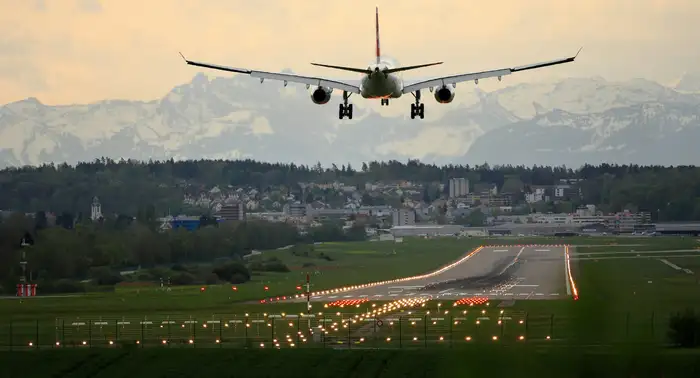
Photo by Pascal Meier on Unsplash